The Police Commissioner is seeking answers after a significant drop in Police College recruits, a development that threatens the government's promise to deliver 500 new frontline officers within its first two years.
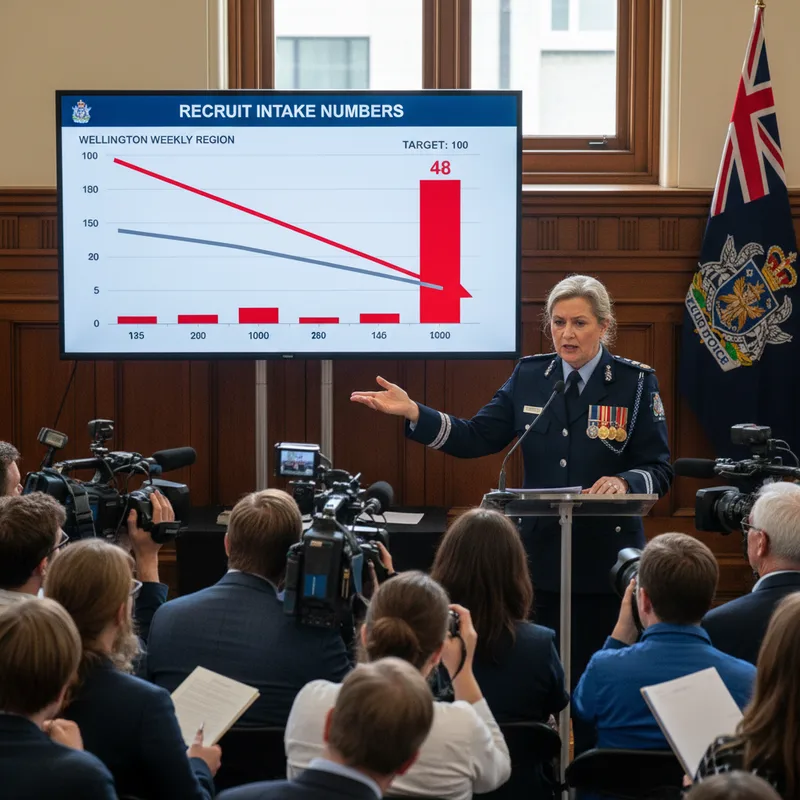
The decline in numbers has been described as 'disappointing' by police leadership, with one recent recruit wing comprising fewer than 50 people. The shortfall prompted Police Commissioner Richard Chambers to call an urgent meeting with recruitment heads earlier this week to address the loss of momentum.
The coalition government, in its agreement from November 2023, committed to training 'no fewer than 500 new frontline police within the first two years'. With the next election just six months away, police data shows an increase of 297 full-time constable equivalents has been achieved so far. There are currently 275 recruits in training across the country.
Recruitment pressure mounts
In response to inquiries, Assistant Commissioner Deployment Jeanette Park said delivering the 500 additional officers is a 'priority programme for NZ Police'. While she noted that the number of applicants 'remains healthy', the recent results have been a cause for concern.
It has been disappointing to see some smaller wing numbers at the College in recent months, including one with fewer than 50 recruits.
Ms Park said the Commissioner made it clear that focus 'must be maintained' on achieving the target. She noted his desire to hit the 500-officer goal as early as possible this year, regardless of the election timetable. 'That relies on ensuring we have good numbers of recruits in training at RNZPC, as well as attrition remaining relatively low,' she says.
The force is working to make its recruiting process more efficient and address any potential hold-ups. Ms Park confirmed a 'strong' pipeline of about 1,000 applicants who are at various stages of the process. 'The Commissioner has asked us to ensure we maintain momentum,' she says.
Government confident despite watchdog's warning
Despite the recruitment dip, Associate Police Minister Casey Costello expressed confidence the target would be met. 'What I've seen is that our numbers are on track, and with usual attrition rates, the extra 500 will be delivered this year,' she said in a statement. 'Our job is to make sure that every part of the pipeline stays strong'.

The Minister's optimism contrasts sharply with the projections from a recent Public Service Commission review of the police. The review, which looked at the force's ability to deliver on government priorities, cited Treasury forecasts that the net increase of 500 constables would not be reached until September 2026, nearly a year after the coalition's original target.
The same report identified several major challenges jeopardising the recruitment programme, including limited capacity at the Royal New Zealand Police College, the financial strain of 'ongoing fiscal pressures', and an ageing workforce. The government's ability to deliver on its key promises remains a central political issue, with senior ministers like Chris Bishop recently dismissing any speculation of leadership challenges within the National Party.
Perhaps the most significant challenge is the continued competitive pressure from Australian police services, which actively recruit New Zealand officers with offers of higher pay and better working conditions. This 'brain drain' affects more than just law enforcement; it's a national issue that sees skilled Kiwis in various sectors, including sports stars like the Hurricanes' star winger Kini Fineanganofo, looking for opportunities across the Tasman.
A question of integrity
The recruitment struggles come as the police force grapples with a scathing report from the Public Service Commission, which stated that 'an integrity reset is urgently needed'. The report highlighted a perceived culture within the force that held senior staff to a 'lesser standard than juniors'. The review said police needed to tackle three 'major challenges' in the coming years: rebuilding police integrity, adapting to complex digital and transnational crime, and improving corporate performance amid financial constraints. This call for a cultural reset comes while the force's own leadership is under scrutiny, with Commissioner Chambers, appointed in November 2024, having previously acknowledged a historic complaint that was upheld against him where he admitted he 'made a mistake'. As an example of the complex digital crimes facing law enforcement, consider the case where the Supreme Court will rule on police use of Google location data.
Increased public scrutiny and the digitisation of records means police actions are more visible than ever, a trend seen across the justice system with new digital tools enhancing public access to court records.
The fight for talent
In an effort to turn the tide, New Zealand Police have ramped up their recruitment efforts. The force has expanded its training capacity by opening an additional campus in Auckland to supplement the main college in Porirua. The current recruit wings at both campuses are reportedly near capacity.
High-profile marketing campaigns, including the 'Ride Along' series, have been launched to attract new blood. Police have also run targeted campaigns to encourage former officers to rejoin the ranks. These initiatives have shown some success, leading to 643 constabulary applications in June 2025, a figure almost two-thirds higher than the previous monthly average.
On a more positive note, the 12-month rolling average for constabulary attrition has fallen to 4.7 per cent, down from 5.7 per cent at the same time last year. As of 20 April, there were 10,508 full-time constable equivalents in New Zealand, not including the 275 recruits still in training.
Ms Park said police are in the 'fortunate position' of being able to increase their numbers. 'It is something that everyone wants delivered,' she said, re-emphasising the commitment to streamlining the process for the nearly 1,000 candidates currently waiting to be assessed.